
The Five Pillars of Passive House Design
- Nadeem F
- Sep 16
- 4 min read

I. Introduction: Unlocking the Potential of Passive House Design
In an era where energy costs are surging and environmental concerns dominate the global agenda, sustainable architecture is no longer a luxury—it’s a necessity. Enter Passive House design: an approach that maximizes comfort while slashing energy consumption. Originating in Germany and now influencing building codes worldwide, the Passive House standard sets rigorous criteria to minimize a home’s ecological footprint while boosting health and affordability. It’s a movement with tangible benefits for homeowners (lower bills, greater comfort), architects (cutting-edge practice), and society at large (reduced emissions, future-ready resilience). The hallmark benefits—outstanding comfort, healthy indoor air, cost savings, and robust sustainability—are transforming how we live and build.
II. The Five Core Pillars of Passive House Design
A. Super-Insulated Building Envelope
The foundation of every Passive House lies in its super-insulated envelope, meticulously crafted to keep heat in during winter and out during summer. By utilizing exceptionally high R-values (and correspondingly low U-values), Passive Houses outperform conventional builds, often doubling or tripling insulation thickness. Optimal R-values may vary by climate, but the philosophy is consistent: surround the living space with a continuous, robust insulation layer. Another critical piece is the elimination of thermal bridges—those sneaky areas where heat slips through the structure. Specialized detailing and continuous insulation ensure comprehensive protection against energy loss, resulting in consistently stable indoor temperatures.
B. Airtight Construction
Airtightness is crucial for Passive House efficiency: the standard dictates an air change rate no higher than 0.6 ACH (air changes per hour) at 50 Pascals of pressure. This is achieved through meticulous air sealing with advanced materials (membranes, tapes, gaskets) and careful workmanship at every joint, seam, and penetration. Rigorous on-site tests—such as blower door testing—validate performance, ensuring there are no drafts or leaks. The payoff includes reduced energy losses, enhanced soundproofing, and improved comfort, as outside air (and pollutants) are kept firmly at bay.
C. High-Performance Windows and Doors
Windows and doors in Passive Houses are anything but ordinary. They feature triple glazing, low-emissivity coatings, insulated frames, and high-quality seals to minimize heat loss. Strategic orientation and placement maximize solar gains in winter while minimizing overheating risks in summer, contributing to the building’s overall energy balance. The result: bright, comfortable interiors and a substantial reduction in heating and cooling needs—without sacrificing aesthetics or views.
D. Mechanical Ventilation with Heat Recovery (MVHR)
A hallmark of Passive House living is continuous fresh air, provided efficiently by mechanical ventilation with heat recovery (MVHR). MVHR systems extract stale indoors air while pre-warming or pre-cooling incoming fresh air using a highly efficient heat exchanger. This not only boosts energy efficiency but also ensures excellent indoor air quality and optimal humidity control. Such systems further prevent mold growth and improve occupant health—a vital consideration for tightly sealed, super-insulated homes.
E. Thermal Bridge-Free Design
Thermal bridges act as “energy leaks,” conducting heat through weak points in the building envelope—like where balconies meet exterior walls or at window sills. In Passive House construction, thoughtful detailing, continuous insulation, and specialized connections eliminate these vulnerabilities. By achieving thermal bridge-free design, the building drastically reduces condensation risks and maintains superior long-term energy efficiency, durability, and comfort.
III. Enhancing Performance: Supplementary Passive House Strategies
Beyond the five pillars, innovative strategies further elevate Passive House performance. Designing with solar orientation in mind ensures the building captures winter sun while shading itself in summer. Compact building forms reduce surface area and exposure, naturally minimizing energy loss. Outfitting homes with energy-efficient appliances, LED lighting, and integrating renewables (solar PV, heat pumps) drives down energy dependence even further. Meanwhile, design features like effective daylighting, high thermal mass, and shading devices maintain comfort with minimal mechanical intervention.
IV. The Impact: How Passive House Components Drive Energy Efficiency
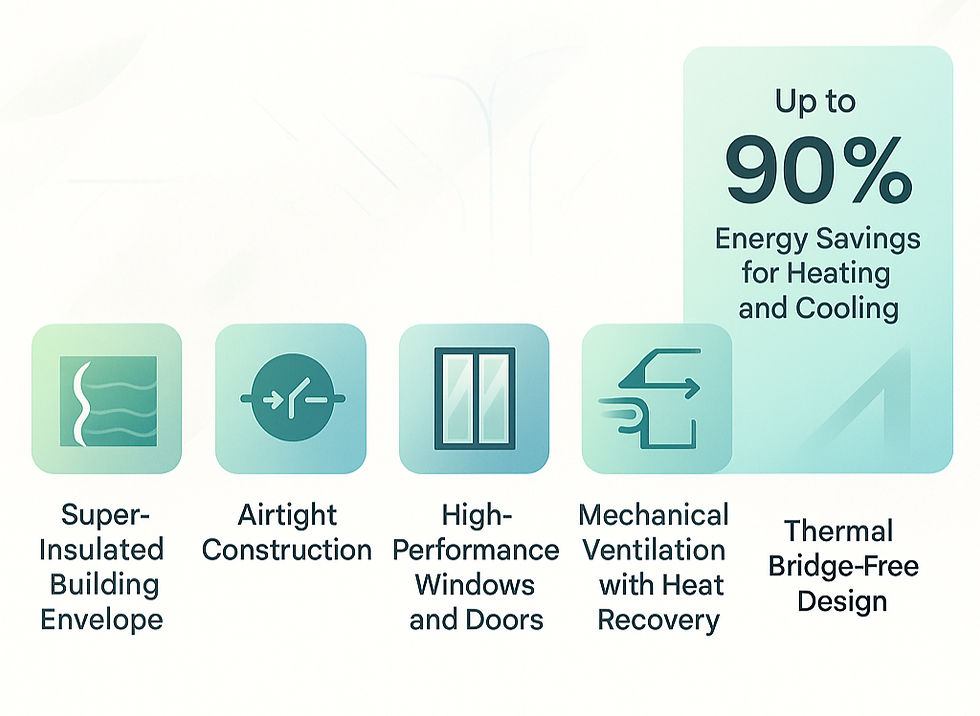
A Passive House’s rigorous approach results in up to 90% less energy demand for heating and cooling compared to typical standards. Consistent insulation, airtightness, and balanced ventilation contribute to steady indoor temperatures and exceptional air quality. Operational expenses—and carbon emissions—drop dramatically. The quality controls baked into Passive House design also yield long-term resilience, asset value, and durability, while the health benefits of clean, fresh, filtered air are proving especially vital in urban environments.
V. Overcoming Challenges: Best Practices and Common Pitfalls
Despite its promise, transitioning to Passive House can present challenges. Misconceptions abound (e.g., “Passive Houses don’t open windows” or “They only work in cold climates”). Navigating certification—whether through the Passive House Institute (PHI) or Passive House Institute US (PHIUS)—requires attention to detail and compliance with evolving local codes. The most successful projects embrace integrated planning and close collaboration between architects, engineers, builders, and clients. Real-world case studies demonstrate that with comprehensive teamwork, achieving Passive House targets is possible across diverse settings and budgets.
VI. Conclusion: Taking the First Step Toward Passive House
In summary, Passive House design intertwines five fundamental components—super-insulation, airtightness, high-performance windows and doors, MVHR, and thermal bridge-free construction—for transformative results. Together, they deliver lasting energy savings, comfort, and health for residents while amplifying the sustainability of our built environment. Whether you’re planning a new build or renovating an existing structure, adopting Passive House principles is an empowering leap toward a comfortable future with a drastically smaller carbon footprint. To take your next step, consider connecting with specialized architects and consultants versed in Passive House methodology, and help weave a more sustainable, resilient world.


Comments